
Products News
SF6 Circuit Breakers
SF6 Circuit Breakers
SF6 circuit breakers are used to interrupt the electrical current flowing between two points in a power distribution system when there is a fault. They are used at substations, for power generation and in renewable energy systems. They are also employed to mitigate faults in transmission lines. They are important because they offer safety, precision and efficiency. SF6 circuit breakers are able to perform a variety of operations, including fault isolation, switching and disconnection. They are also capable of reducing the impact of arc-induced fires and explosions, thereby protecting the equipment and human beings from harm.
There are various types of SF6 circuit breakers, but they all have the same fundamental characteristics. They have high insulating and dielectric strength, arc quenching and excellent interrupting performance. In addition, they have very low arcing temperature and are non-flammable. However, SF6 circuit breakers are not easy to design and require high processing accuracy, good sealing performance and strict testing requirements.
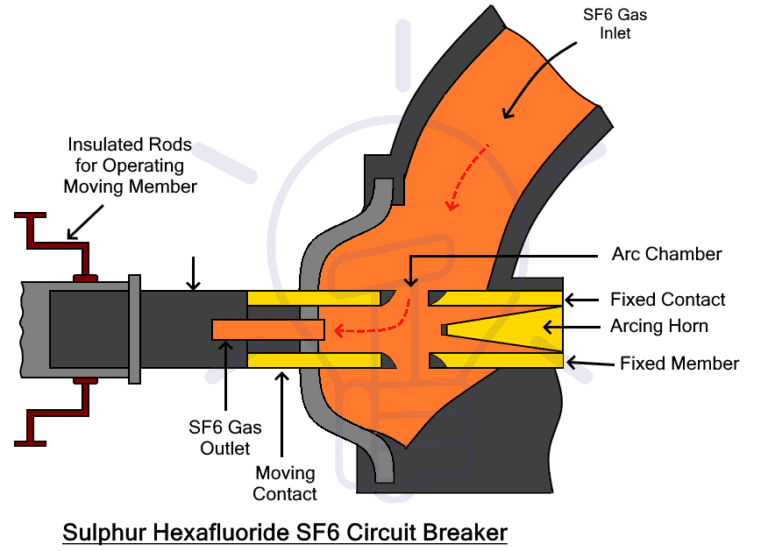
The main function of an SF6 circuit breaker is to interrupt currents and the resulting arc that occurs when a contact is broken or opened. To do this, the SF6 circuit breaker has moving and fixed contacts that are enclosed in a chamber called the arc interruption chamber. This arc interruption chamber is linked to an SF6 gas reservoir via a valve mechanism. When the SF6 circuit breaker is activated, the valve opens, allowing a high-pressure SF6 gas to flow into the arc interruption chamber.
As the valve closes, the SF6 gas is pushed back and out of the arc interruption chamber. When the arc is induced, the moving and fixed contacts move apart and an arc is struck between them. The movement of the contacts is synchronized with a valve that enters the high-pressure SF6 into the arc interruption chamber at a rate of about 16kg/cm
SF6 is also effective in removing moisture and contaminants from the arcing plasma. This helps to ensure that the arc is quickly quenched and the switching capacity of the CBs is not affected. However, the use of SF6 is controversial because it has high global warming potential and there is an active search for alternatives with comparable arc-quenching and insulating properties.
The SF6 circuit breaker has a closed gas system that contains a reservoir of SF6 and a warning alarm. The SF6 gas is costly, so it must be reclaimed after each operation. To do this, the circuit breaker has low and high-pressure chambers. When a warning switch is activated, the system will alert you if the SF6 pressure has dropped too low to prevent arc-interrupting capability. It will also provide you with a means of restoring the pressure to a safe level.
Tags:air circuit breaker | molded case circuit breaker | sf6
0users like this.
