
Products News
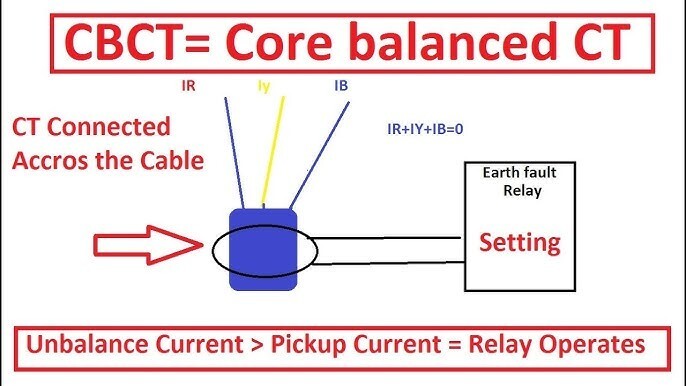
Core Balance Current Transformer
Core Balance Current Transformer
A core balance current transformer, also known as a zero sequence current transformer (ZCT), is a special type of current transformer that detects a fault condition and provides an earth leakage protection signal to a relay. It consists of a current transformer core and an electrically isolated secondary winding. The magnetic flux generated by the primary conductor that connects to the CBCT’s secondary winding induces an electromotive force in the secondary winding that represents a proportional value of the primary current. This signal is then used for monitoring, measuring or protection purposes.
Unlike other current transformers, core balance current transformers are not susceptible to magnetic saturation, meaning that they provide a consistent measurement of current in all operating conditions. These benefits make them ideal for use in applications such as motor protection circuits. Additionally, since CBCTs are non-directional, they can be installed without disrupting the flow of power. Simply clamp them around the conductor and they will begin producing a signal proportional to its current.
In the absence of a fault condition, all three phase currents are equal in magnitude and have perfect symmetry. This is referred to as zero-sequence current balance or zero-sequence current equilibrium, and it is the basis for the operation of core balance current transformers.
A typical three-phase zero-sequence system contains a set of current transformers for each phase. When the phases are healthy, they will all produce a zero-sequence current. Consequently, the residual current that flows through the zero-sequence CTs is also equal to zero. Since the residual current is a vector quantity that is directly proportional to the corresponding current, the residual current’s consequent magnetic field flux is also zero.
However, when a fault occurs, the zero-sequence current transformers start to develop different residual currents, resulting in a non-zero voltage across the secondary winding of the CBCT. The resulting current in the CBCT’s secondary is proportional to the difference in the vector angles of the phase currents and induces an electromotive force that is a direct representation of the primary current. This signal is then passed to a relay via the secondary winding of the CBCT and energises it.
CBCTs are typically mounted over a cable close to where it passes through the cable gland on switchgear or other apparatus. They are normally of the ring-type, through which cables of all three phases pass. This is where they differ from other types of current transformers, which are commonly installed at a point further away from the switchgear.
One of the main disadvantages of a core balance current transformer is that it is not suitable for measuring direct current(DC). It only operates with alternating current(AC), which is what most conductors in industrial settings are carrying. This means that a DC-only conductor would not be accurately measured by a CBCT, unless it was very large. Another disadvantage is that CBCTs cannot be used with multiple conductors at once, as they only measure the current in a single conductor. This makes them less effective for large power systems and is a major reason why they are rarely used in transmission or distribution circuits.
Tags:cost of current transformer | ground transformer | pole transformer
0users like this.
