Industry News
The Basic Parts of a Transformer
The Basic Parts of a Transformer
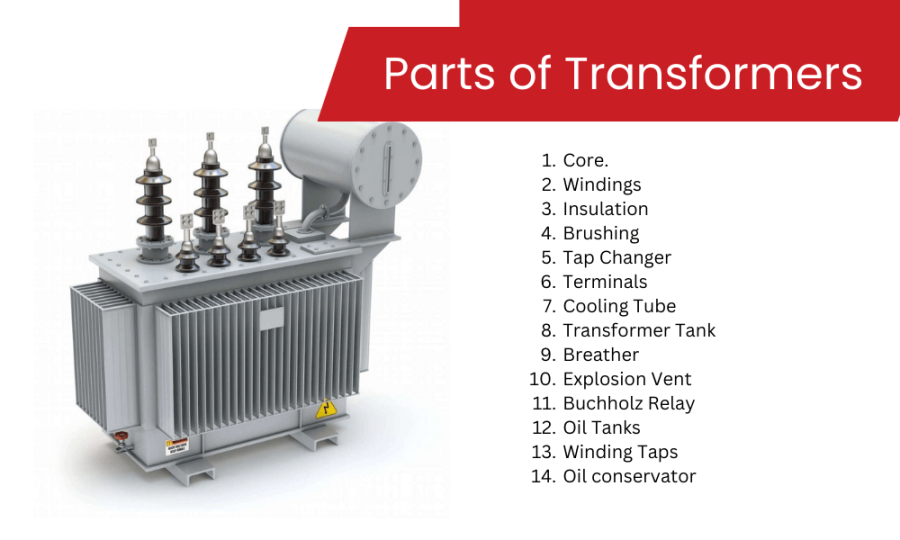
A transformer is an electrical device that steps up or down the voltage of alternating current (AC).transformer parts There are many parts to a transformer, but the primary ones are a laminated soft iron core and windings. There are also insulating material, cooling arrangements and protection relays present in larger transformers.
Working on the principles of electromagnetic induction, a transformer can step up or down AC voltage by changing magnetic flux linkage between the secondary and primary coils.transformer parts The varying magnetic field produced by the primary winding creates EMF that induces a changing flux linkage in the second winding. The induced EMF is proportional to the number of turns in the second winding, thereby producing the desired output voltage.
The core is the center of a transformer and provides a low-reluctance path for magnetic flux to link with the primary and secondary windings.transformer parts It is usually made of a lamination of ferrite or powdered iron sheets or a solid metal alloy such as silicon steel, permalloy or tin. Its ring-shaped design improves efficiency by eliminating air gaps.
There are several different types of cores that can be used depending on the application and the operating frequency of the transformer.transformer parts For instance, for high-frequency applications, a toroidal core with a circular cross section is more efficient than an elliptical core.
Coils are copper wires wound around the core to produce alternating currents.transformer parts Each coil has a certain number of turns that directly correlates to the output voltage of the transformer. The higher the turns, the greater the voltage. Often, multiple sets of windings are required for different load requirements. A transformer with two sets of coils is known as an autotransformer and one with more than two sets is called a step-up or power-factor correction (PFC) transformer.
A transformer must have good insulation to reduce the effects of heat on the windings and core.transformer parts This is achieved by using insulating materials with high dielectric strength, the ability to withstand temperature variations and robust mechanical properties. Common insulating material include paper, cotton and synthetic fibers.
Another critical component of a transformer is the oil.transformer parts It serves several purposes including providing extra insulation between conductors, cooling the transformer and preventing damage due to internal short circuits. Larger transformers use a tank to store the oil, and there are also piping and connections that connect the tank to other parts of the transformer.
In addition to the oil, there are also a variety of other accessories that can be found in larger transformers such as indicators, pressure and temperature sensors and Buchholz relays for detecting faults. The Buchholz relay is a special type of sensor that is used in transformers rated over 500kVA and operates on the gases emitted by the breakdown of the transformer oil during internal faults. The Buchholz relay can help detect this early and prevent the system from continuing to operate with a failing core or other component. This reduces downtime and increases energy efficiency.
Tags:mobile substation transformer | laminated core transformer | amorphous core transformer
0users like this.